Dispensed by Regulated UK Pharmacists
100% Discrete Packaging
FREE Delivery on orders over £49 (under 8kg)*
VMD Registered
Dispensed by Regulated UK Pharmacists
100% Discrete Packaging
FREE Delivery on orders over £49 (under 8kg)*
VMD Registered
It is essential that you register your pets individually with Pet
so
that our Registered Qualified Persons (RQPs) can ensure all
prescribed
and restricted products are being purchased for the correct species
according to weight and size.
£250.30£254.32
100 g
Description
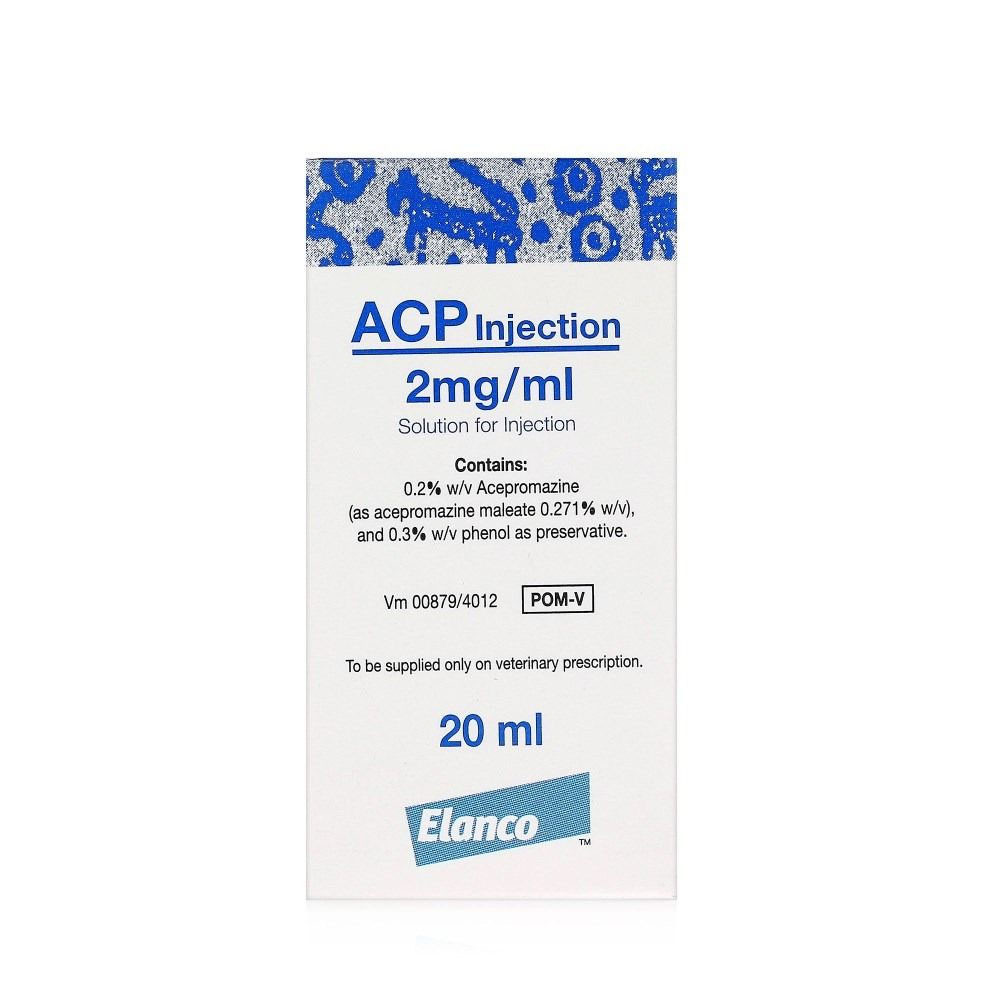
ACP Injection 2 mg/ml Solution for Injection is a prescription-only veterinary medicine licensed for use in dogs and cats, formulated as a pale yellow aqueous solution for intramuscular, subcutaneous, or slow intravenous injection. Each ml contains acepromazine 0.2% w/v (as acepromazine maleate 0.271% w/v) — a phenothiazine that acts as a central nervous system depressant through inhibition of dopamine pathways, producing alteration of mood, reduction in fear, and removal of learned or conditioned responses. Acepromazine also possesses anti-emetic, hypothermic, hypotensive, and anti-spasmodic properties, and shows a marked potentiating effect on barbiturate anaesthesia. It is a POM-V product and requires a valid veterinary prescription prior to dispensing.
ACP Injection is indicated for three clinically distinct uses in dogs and cats:
For Dogs and Cats:
Anaesthetic Premedication: Following acepromazine administration, the amount of anaesthetic necessary to induce anaesthesia is considerably reduced — this reduction is approximately one-third of the dose of a suitable induction agent
Tranquilisation (ataraxy): At low doses, acepromazine produces a modification of temperament that is not associated with hypnosis, narcosis, or marked sedation
Sedation: At higher dose rates, acepromazine acts as a sedative
Normally, single doses of acepromazine are administered. Long-term use is not permitted (see Contraindications).
Which Animals Can Use ACP Injection?
ACP Injection is licensed for use in dogs and cats only. It must not be used in pregnant animals, and must not be used on a long-term basis in individual animals. Special caution is required in hypovolaemic animals, Boxer dogs and other brachycephalic or short-nosed breeds, and large breeds of dog (see Important Warnings). Always use only under the direction of your vet.
Available Strengths & Sizes
Presentation
Pack Size
2 mg/ml Solution for Injection
20 ml Clear Glass (Type II) Vial
Shelf life after opening (first dose withdrawal): 28 days — use remainder within 28 days of first opening; discard any unused material. Store below 25°C and protect from light.
Directions for Use
ACP Injection is a prescription medication and must be used exactly as directed by your veterinary surgeon. The product is administered by intramuscular (IM), subcutaneous (SC), or slow intravenous (IV) injection. For intravenous use, the injection must be made slowly — rapid intravenous injection may cause cardiac dysrhythmia. Subcutaneous injection is non-irritant and particularly efficacious in cats.
The maximum dose that should be given is 4 mg acepromazine per animal, regardless of bodyweight.
Normally, only a single dose is administered. Take adequate precautions to maintain sterility; avoid the introduction of contamination during use. Should any apparent growth or discolouration be observed, discard the product.
Use
Dose
Route
Premedication
0.03–0.125 mg/kg BW
IM, SC, or slow IV
Tranquilisation / Sedation
0.0625–0.125 mg/kg BW
IM or SC
Tranquilisation / Sedation
As for IM, made slowly
IV
For guidance: 0.0625–0.125 mg/kg corresponds to approximately 0.625–1.25 ml of the 2 mg/ml injection per 20 kg bodyweight.
Contraindications
Source: SPC Section 4.3
Do not use in pregnant animals — no formal safety studies have been conducted in pregnant animals
Do not use on a long-term basis in individual animals — normally only single doses are administered
Storage & Handling
Do not store above 25°C. Protect from light. Keep the vial in its outer carton. Following withdrawal of the first dose, use the remainder of the product within 28 days. Discard any unused material after 28 days. Dispose of unused product in accordance with local requirements. Keep out of the sight and reach of children.
Withdrawal period: Not applicable.
Important Warnings
Source: SPC Sections 4.4, 4.5, 4.6, 4.7 & 4.8
Hypotension: Acepromazine is hypotensive; particular care must be taken in hypovolaemic animals — rehydration should precede acepromazine administration in all cases where hypovolaemia is present or suspected
Boxers and brachycephalic/short-nosed breeds: In some dogs, particularly Boxers and other short-nosed breeds, spontaneous fainting or syncope may occur due to sinoatrial block caused by excessive vagal tone; acepromazine may precipitate such an attack; a low dose should therefore be used; where there is a history of this type of syncope, or if it is suspected due to excessive sinus arrhythmia, it may be advantageous to control the dysrhythmia with atropine administered just before the acepromazine
Large breeds: Large breeds of dog are particularly sensitive to acepromazine; the minimum dose possible should always be used in large-breed dogs
Cardiac dysrhythmia: Cardiac dysrhythmia may follow rapid intravenous injection; intravenous doses must always be administered slowly
Sterility: Take adequate precautions to maintain sterility; avoid the introduction of contamination during use; if any apparent growth or discolouration is observed, discard the product immediately
Drug interactions — CNS depressants: Acepromazine is additive to the actions of other depressants and will potentiate general anaesthesia; when used as an anaesthetic premedicant, the dose of the induction agent should be reduced by approximately one-third; inform your veterinary surgeon of all current medications
Single dose only: Long-term use is contraindicated; acepromazine is normally administered as a single dose only
Overdose — hypotension: Transient dose-dependent hypotension may occur in cases of accidental overdose; treatment should consist of discontinuing any other hypotensive treatment, intravenous infusion of warm isotonic saline to correct hypotension, and close monitoring
CRITICAL — Epinephrine contraindicated in overdose: Epinephrine (adrenaline) is contraindicated in the treatment of acute hypotension produced by acepromazine overdose, as its use can result in further depression of systemic blood pressure; if overdose is suspected, emergency veterinary care must be sought and epinephrine must not be administered
Pregnancy: The safety of ACP Injection has not been established during pregnancy; use in pregnant animals is contraindicated
Human safety — Accidental self-injection: Take precautions to avoid accidental injection or self-administration of this potent drug; in case of accidental self-injection, seek medical advice immediately and show the package leaflet or the label to the physician; symptomatic treatment may be required; do not drive as sedation may occur
Human safety — Eye contact: Avoid contact with eyes; if accidental eye contact occurs, flush gently with fresh running water for 15 minutes and seek medical advice if any irritation persists
Human safety — Skin contact: In the event of accidental skin contact, wash the contaminated area with large amounts of soap and water; medical advice should be sought if irritation persists
Wash hands and exposed skin thoroughly after use
POM-V Prescription Notice
This product is a Prescription Only Medicine — Veterinary (POM-V). It may only be supplied by a veterinary surgeon or, when prescribed by a veterinary surgeon, by a pharmacist or SQP. A valid veterinary prescription is required before this product can be dispensed.